



Take a look at some of our other public sector references
Your expert in sewage sludge recovery
Thanks to its know-how and innovative processes, REMONDIS Aqua is the company to turn to when it comes to recycling municipal and industrial sludge. And the same is true for infrastructure waste and/or residue generated by wastewater treatment systems (screenings, grit chamber residue, sand from sewers). Both our expertise and our extensive plant capacities make it possible for us to guarantee that we can provide a reliable, long-term service. This is something that will become even more important in the future when local authorities find themselves facing the genuine problem of having to recover and recycle the phosphorus in their sewage sludge from 2029 onwards – a statutory obligation set out in the German Federal Sewage Sludge Ordinance [AbfKlärV] when it was amended in 2017. On top of this, sewage sludge will no longer be able to be co-incinerated in cement kilns and coal-fired power stations in the future.
It’s not just quantity that’s important when it comes to recycling sewage sludge but quality as well, of course. And so it’s good to know that we accept all types of sewage sludge – no matter how contaminated it is or what its origin – and are able to recover the phosphorus and recycle it for reuse. We are always able to find the best treatment solution for each individual case within our nationwide network of plants and facilities. By the way, this is also true for the logistics. We have the perfect set-up thanks to digitisation and collaborations with over 200 haulage firms – ensuring we remain close to our customers and smart transport routes and deliver efficient, standout services.
Sewage sludge recycling – who to contact:
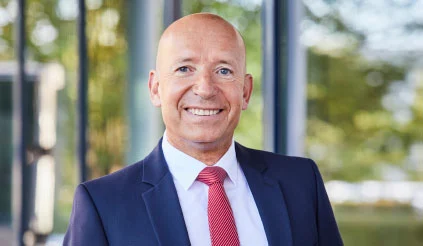
Ralf Czarnecki
Go straight to the benefits
A full range of sewage sludge recycling services

Concept development
We draw up bespoke treatment and recycling concepts – from dewatering and drying sludge, to emptying and treating the contents of sludge drying beds, all the way through to removing and processing wet sludge from settling ponds.

Internationality
We offer our sludge treatment services throughout Germany and Europe. Across all regions and across national borders.

Permits & notifications
We always look to support our customers wherever we can which also means helping them apply for permits. If requested, we can also help them with the notification procedure for transboundary shipments.

Logistics
We are able to organise the transport of sludge by road, rail and ship and can offer the most suitable solution here as well.

Pre-treatment
We handle the dewatering, conditioning and drying of the sludge residue to make the recycling process easier for you. All in all, we offer a comprehensive range of services for sewage treatment plant operators.

Documentation
We prepare the necessary documentation, such as waste disposal certificates, to make things as easy as possible for our customers.

We firmly believe that thermally treating sewage sludge without recovering the phosphorus is not recycling the sewage sludge!
The future of sewage sludge recycling. Even today
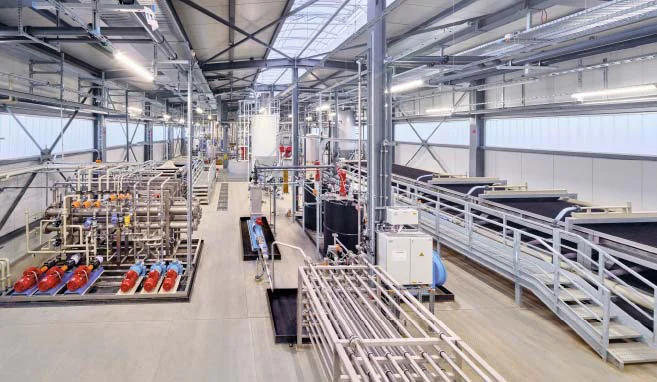
In our view, the ideal approach to sewage sludge recovery is, without a doubt, the combination of energy recovery and phosphorus recycling. This process eliminates organic pollutants whilst also recovering valuable materials such as phosphorus and metals, as well as energy. Here at REMONDIS Aqua, we are extremely proud to offer a solution that represents the highest possible level of sewage sludge recovery by European standards. We were already committed to phosphorus recycling and had developed patented processes for this purpose long before the issue had gained any significant traction in political or business circles. The result: the world’s first large-scale phosphorus recycling plant, established as part of a public-private partnership with the Free and Hanseatic City of Hamburg.

Bespoke partnerships. On an equal footing
We see ourselves as being a customer-oriented service provider when it comes to recycling sewage sludge. This means that we handle and treat your sewage sludge exactly as you wish us to do. Our overall goal here is to find the most cost-effective and suitable treatment method. No matter whether we take the sewage sludge from our municipal and industrial customers to treat it in our own facilities or collaborate with our customers to build a sludge treatment facility on their grounds and then operate it on their behalf. All the while remaining true to our premise that we always share our knowledge and experience of recovering phosphorus if doing this has a positive and sustainable impact. Another important aspect here: the closer and longer we cooperate with one another, the more you benefit as our customer. For example, when it comes to having access to long-term, reliable waste management solutions, to ensuring plant availability and to achieving cost reductions. This also makes us an attractive partner for public private collaborations tasked to provide key public sector services.
Using infrastructure waste as a resource
Residual materials from wastewater treatment and municipal sewer cleaning also contain valuable raw materials and energy potential. These include, for example, screenings and rakeings, sand trap residues, and sewer sand. Our goal is not merely to dispose of these materials, but to return them to the economic cycle through appropriate treatment and recovery processes. Depending on the type and composition of the residual materials, we develop customized concepts for material and energy recovery. Processed materials can be used, for example, in road construction or land reclamation projects. In energy recovery, the calorific value contained in the material is utilized to generate energy. This allows for the safe removal of pollutants while simultaneously reducing reliance on fossil fuels. In addition, we handle all regulatory compliance on your behalf, prepare the necessary disposal certificates, and organize efficient logistics for infrastructure waste.
For safe collection and temporary storage at wastewater treatment plants, our RESAFE-IT box system provides enclosed, flexible-use containers.
Would you like to find out more about how we can support you in the area of sewage sludge recycling? Then give us a call or use our contact form.
Sewage sludge recycling references
Proper water management should always include material flow management and sewage sludge recycling. And that’s not just our opinion. Our many German and European customers think the same, some of who have been working with us for many years now. We have listed a few of them from Germany below so that you can find out more. First-hand accounts that will win you over.

Hamburger Phosphorrecyclinggesellschaft mbH
HPHOR (Hamburger Phosphorrecyclinggesellschaft mbH) – a public-private partnership between HAMBURG WASSER and REMONDIS Aqua – has built the world’s first large-scale phosphorus recovery plant in Hamburg. The aim is to use the patented REMONDIS TetraPhos® process to recover 7,000 tonnes of high-quality phosphoric acid, known as REPACID®, from 20,000 tonnes of input material per year. The process was honoured with the GreenTec Award back in 2016.
Stadtentwässerungsbetriebe Köln AöR
We have been responsible for transporting and recycling the sewage sludge (almost 80,000 tonnes per year) from the five sewage treatment plants located across Cologne on behalf of Stadtentwässerungsbetriebe Köln (StEB Köln). What’s more, we also treat the screenings in the city’s waste incineration plant and the grit chamber residue in regional soil treatment facilities. Working closely together with REMONDIS Aqua, Stadtentwässerungsbetriebe Köln is continuously looking to optimise its processes. The benefits for StEB Köln are obvious: the whole range of services needed by the company is provided by REMONDIS Aqua – from the in-house logistics, to the transport, through to the final treatment of the material. The situation at the main sewage treatment plant in Cologne-Stammheim is particularly unusual. Being one of the largest sewage treatment plants (1,570,000 population equivalents) in the German state of North Rhine-Westphalia, the sewage sludge has to be collected and transported away for treatment 365 days a year. Cologne’s sewage sludge is converted into steam and electricity through incineration, thereby being used to generate energy.
Rhein-Neckar-Phosphor-Recycling GmbH & Co. KG
Rhein-Neckar-Phosphor-Recycling GmbH & Co. KG is an alliance between practically all of the sewage treatment plants (with more than 750,000 population equivalents) located in the Rhine-Neckar District. REMONDIS Aqua is responsible for transporting and recycling the 30,000 tonnes of sewage sludge from these plants. REMONDIS Aqua uses sewage sludge to generate energy and can therefore help to reduce the use of fossil fuels.
City of Kiel
The Bülk sewage treatment plant in Strande treats 19 million cubic metres of wastewater every year – which means it handles, on average, 52,000 cubic metres of wastewater a day. Each year, the wastewater treatment processes produce around 36,000 Mg of sewage sludge (original substance). This material used to be treated in plate-and-frame filter presses with iron and lime. The limed sludge has not been allowed to be spread on agricultural land since 2020 because of its increased mercury content and has been thermally treated since then. The plate-and-frame filter presses were decommissioned in September 2022. At the moment, the sludge is mixed with polymer additives, dewatered using centrifuges and thermally treated to generate energy.
City of Lübeck
Entsorgungsbetriebe Lübeck operates two sewage treatment plants in the City of Lübeck – the main sewage treatment plant (the ‘ZKW’ in the Warthestraße) and the Priwall sewage treatment plant in Travemünde. Since being commissioned in 1967, the ZKW has been steadily extended and upgraded. So much so, in fact, that it is now one of the largest and most modern sewage treatment plants in the German state of Schleswig-Holstein. Each year, around 20 million cubic metres of wastewater (around 420,000 population equivalents) undergo high quality treatment. The concentrated raw sludge from the Priwall sewage treatment plant is transported to the ZKW so that it can be treated together with the main plant’s sludge. All of the sewage sludge is first stabilised using anaerobic processes, dewatered and then stored in a silo before being taken on for further treatment. Approximately 22,500 Mg of dewatered sewage sludge (original substance) is generated here; all of it is thermally treated to generate energy.
You might also be interested in …

Municipal drinking water management
Extensive expertise – from sourcing raw water all the way through to supplying drinking water.
more

Municipal wastewater management
A whole range of services covering wastewater treatment – from delivering infrastructure services through to managing plant operations.
more

Services
We offer engineering services, analytical services and much, much more.
more
REMONDIS Aqua Company locations
The whole picture – with just a single click. Find out here where our branches are located, what services they offer and how to contact them.
REMONDIS Group locations
Discover the world of REMONDIS with its 1,500+ branches and associated companies in more than 30 countries across Europe, Africa, Asia and Australia.