





How TetraPhos® works
Phosphorus recovery is becoming increasingly important.
Thank goodness
Recovering phosphorus is the future for the majority of sewage treatment works in Germany. All large sewage treatment plants in Germany will be obliged, by law, to recover the phosphate from their municipal sewage sludge from 2029 onwards. From our point of view, it is already clear that other European countries will follow suit. Having said that though, it would be wrong to consider the subject of phosphorus recovery merely from the point of view of whether it meets statutory requirements or not. Almost all of the world’s phosphorus reserves are outside Europe making it a very scarce raw material. Recovering phosphorus so that it can be reused is simply something that makes sense. That is especially true when it involves sewage sludge, which is such a rich source of raw materials. The amount of sewage sludge produced in Germany alone contains around 60,000 tonnes of phosphorus.
Phosphorus recovery – who to contact:

Andreas Rak
Gregor Timmerhaus

Why local authorities should count on
REMONDIS Aqua to recover their phosphorus
We realised very early on just how much potential sewage sludge has. We developed TetraPhos® – our patented phosphorus recovery process, which has already been implemented on an industrial scale. Sewage sludge ash, the residual material from thermal sewage sludge utilisation, is used to produce high-purity phosphoric acid, which can be used to produce fertiliser for agriculture, for example. This acid can also be used for many other industrial applications, for example for protecting against corrosion. Thanks to our know-how and experience in this area, you can rest assured that you will be able to successfully recover phosphorus as part of your municipal wastewater treatment system. As a general rule, the earlier this subject is tackled, the better.

The benefits of having your own TetraPhos® facility
Use of secondary raw materials
Several material cycles are closed at once, and high-quality secondary raw materials are produced.
Nutrients & pollutants safely separated
Recycled phosphoric acid is a fully marketable, widely used and versatile secondary raw material.
Legally compliant
Phosphorus is removed from the sewage sludge in accordance with the amendment to the Sewage Sludge Ordinance (AbfKlärV) adopted in Germany, thereby ensuring the long-term viability of the plants.
Getting the right advice about recovering phosphorus from the start
More and more local authorities and water associations are deciding to invest in mono-combustion plants for treating their sewage sludge as they are well aware that it will soon be mandatory for them to recover phosphorus and that there are not enough suitable recycling capacities available. REMONDIS Aqua is just the right company to discuss these projects with and, if you wish, to implement them on your behalf. At the end of the day, anyone planning to build a plant to thermally treat sewage sludge must automatically also be thinking about having a future-proof system – i.e. one that includes phosphorus recovery – considering the long time needed to realise such projects. We can help you to draw up a concept and build your incineration plant so that your sewage sludge ash is recycled in the best possible way and your plant has the right general set-up for recovering phosphorus. For example, by having the plant produce steam that can then be used for the phosphorus recovery process.
From 2023 onwards, operators of large sewage treatment plants must present a concept showing how they intend to recover their phosphorus. This decision was set out in law in October 2017.
We’re more than happy to meet you to discuss how we can help you to recover your phosphorus. Simply get in touch with us

Recovering phosphorus from sewage sludge
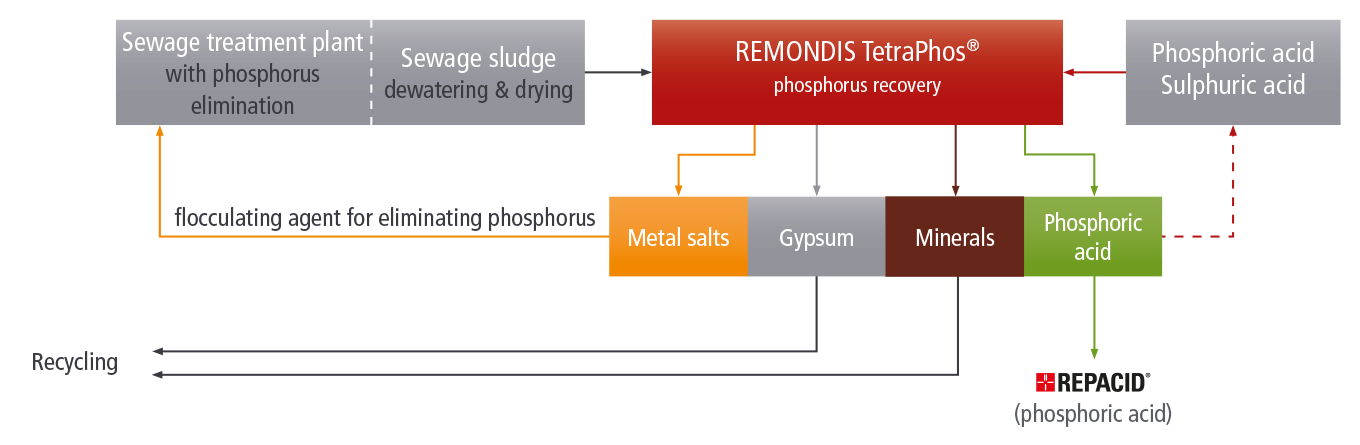
Our TetraPhos® technology turns sewage treatment plants into urban mines and a source of raw materials. We make the very most of the fact that the ash left over after the sewage sludge has been incinerated still contains a large amount of recyclable substances. Including phosphorus. We recover this by using the thermal pre-treatment stage and a physical-chemical process. We use the sewage sludge to generate energy and then mix the sewage sludge ash with phosphoric acid so that the acid is enriched with the phosphate in the ash. The result is a high-quality phosphoric acid called REPACID®.
How phosphorus is recovered with TetraPhos®

Phosphorus – a vital substance
If you’re asking yourself why the spotlight is being turned on phosphorus recovery and why international and national legislation is driving this subject forward, then you simply need to take a look at the world’s phosphorus resources. Practically all deposits of phosphate rock are found beyond the European continent and are mined in regions that sometimes have a politically complex landscape. For example in Morocco, China, Jordan, Russia and South Africa. Which means that Europe is dependent on imports of a raw material that is essential for all life on our planet and that is in danger of becoming more and more scarce as the world’s population increases. Studies – including studies from the German Environmental Agency (UBA) – forecast that there will be a worldwide shortage of phosphorus from 2070 onwards. Reason enough, therefore, to recover and recycle this precious raw material and take a step further towards becoming less dependent on the global market.
A cycle within a cycle
A distinctive feature of the TetraPhos® process is that it creates a self-sustaining cycle. The iron and aluminium salts that are recovered from the sewage sludge ash alongside the phosphorus can be reused by the sewage treatment plants to eliminate phosphate. And, of course, some of the acid produced by the phosphorus recovery process remains in the cycle so that it can be reused to recover more phosphorus. What’s more, this system also generates recycled gypsum and minerals of a consistently high quality that can be marketed for a variety of applications. Both are used by the building supplies trade – helping to reduce demand for virgin raw materials in this sector, too.
Why recycled phosphorus?

Reason 1: High quality
Phosphorus imported from opencast mines is often contaminated with heavy metals and uranium. Our recycled product, REPACID®, is not exposed to these contaminants.

Reason 2: Lower dependency on imports
Recycled phosphorus acts as a safeguard against raw material shortages and the vagaries of the sometimes volatile and politically unstable markets.
Sewage sludge on our fields? Requirements are changing
Another argument in favour of phosphorus recycling using TetraPhos® is that the direct material recovery of sewage sludge is increasingly becoming obsolete. Whilst the spreading of sewage sludge on farmland is currently still permitted in many countries, provided certain limit values are observed, the trend in Germany suggests that the regulations are being gradually tightened. This is consistent with the fact that regulations in Germany are being progressively tightened. From 2029, sewage treatment works with a population equivalent of over 100,000 must carry out phosphorus recycling; by 2032, this will apply to those with a population equivalent of over 50,000. Strictly speaking, the use of sewage sludge as fertiliser also counts as phosphorus recycling. In our view, however, this remains a questionable solution, as it is potentially harmful to the environment. Consequently, it makes more sense for the agricultural sector to produce phosphate fertilisers based on recycled material than to continue spreading tonnes of sewage sludge – which is more or less contaminated – onto the land. Especially as recycled phosphorus can also be put to excellent use in other ways. In animal feed production, for example.


So are there phosphorus recovery systems for industry, too?
Phosphorus can also be found in industrial wastewater depending on which sector our customers operate in. Having said that though, industrial wastewater has two disadvantages compared to wastewater in municipal sewage treatment plants when it comes to recovering phosphorus: the composition of the industrial wastewater is considerably more heterogeneous across all customers and the volumes produced are much smaller. Both these factors mean that REMONDIS Aqua uses a different solution here. The name of this solution is REPHOS®. This is a process that we developed ourselves as part of our industrial wastewater treatment operations. This system enables phosphorus to be removed straight from the wastewater as magnesium-ammonium-phosphate (MAP).
You might also be interested in …

Research & Development
Many other technologies are available, such as smart sensor technology for sewers.
more

Municipal wastewater management
A whole range of services covering wastewater treatment – from delivering infrastructure services through to managing plant operations.
more

Services
We offer engineering services, analytical services and much, much more.
more
REMONDIS Aqua Company locations
The whole picture – with just a single click. Find out here where our branches are located, what services they offer and how to contact them.
REMONDIS Group locations
Discover the world of REMONDIS with its 1,500+ branches and associated companies in more than 30 countries across Europe, Africa, Asia and Australia.